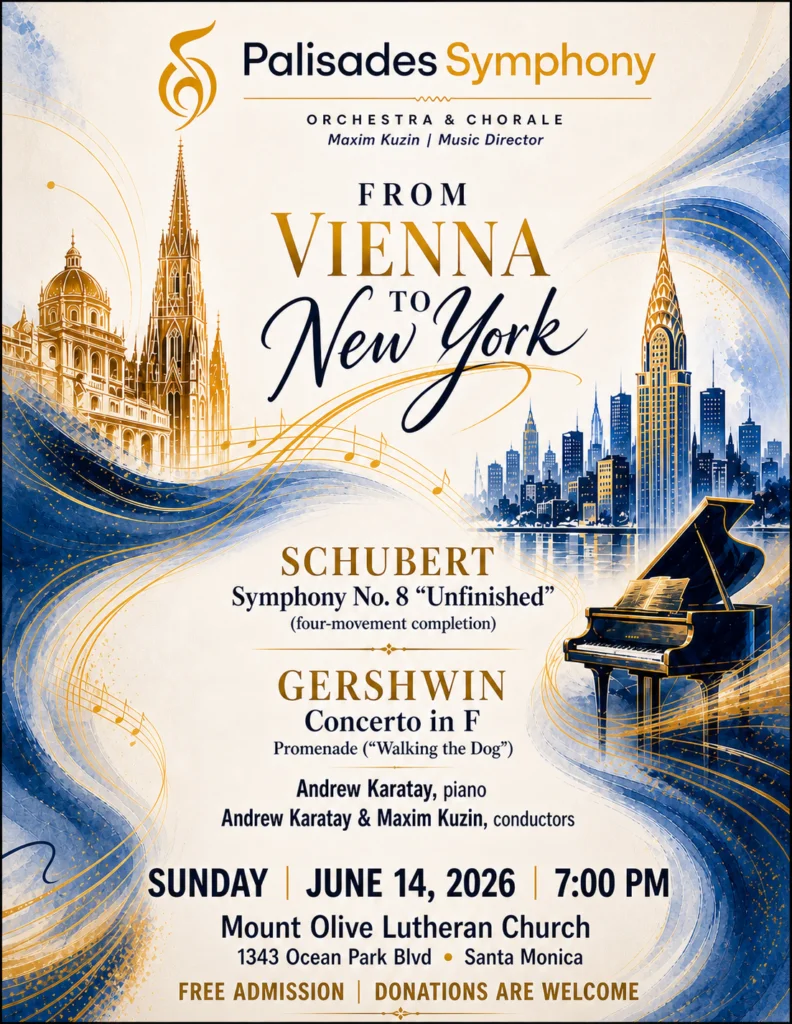
June 14, 2026 | 7 PM Mount Olive Lutheran Church | 1343 Ocean Park Blvd, Santa Monica, CA, 90405
Franz Schubert’s “Unfinished” Symphony has enchanted audiences for nearly two centuries — how could it not? Its unrestrained melodic beauty and heartbreaking expressiveness move listeners of every background and age. And yet: it is unfinished. No symphony can truly satisfy ending with its second (slow) movement, and for almost 200 years listeners have wished they could hear the rest.
Oddly enough, it turns out that “the rest” may be more or less recoverable. Schubert sketched a third movement, a Scherzo, before setting the work aside. And he wrote what may well have been the intended finale — in nearly identical key and scoring — as incidental music for the contemporary play Rosamunde. The 20th-century conductor and composer Felix Weingartner completed and orchestrated the Scherzo. Together with the Rosamunde music, we now have all four movements — and that is precisely what Palisades Symphony will perform on June 14, with Andrew Karatay on the podium.
Then, George Gershwin. The Piano Concerto in F is one of the great American orchestral works — a piece that crackles with jazz harmony, blues expressiveness, and Broadway verve, while holding together as a fully serious concert composition. Written in 1925 and premiered at Carnegie Hall, it established once and for all that Gershwin was not merely a songwriter but a symphonist. Music Director Maxim Kuzin leads the orchestra, with Andrew Karatay as piano soloist — a singular pairing: two conductors who meet as pianist and orchestra.
And to close: Gershwin’s irresistible “Walking the Dog” (from the 1937 film Shall We Dance) — pure wit and charm — with Andrew Karatay at the piano and Dr. Kuzin conducting from the podium.